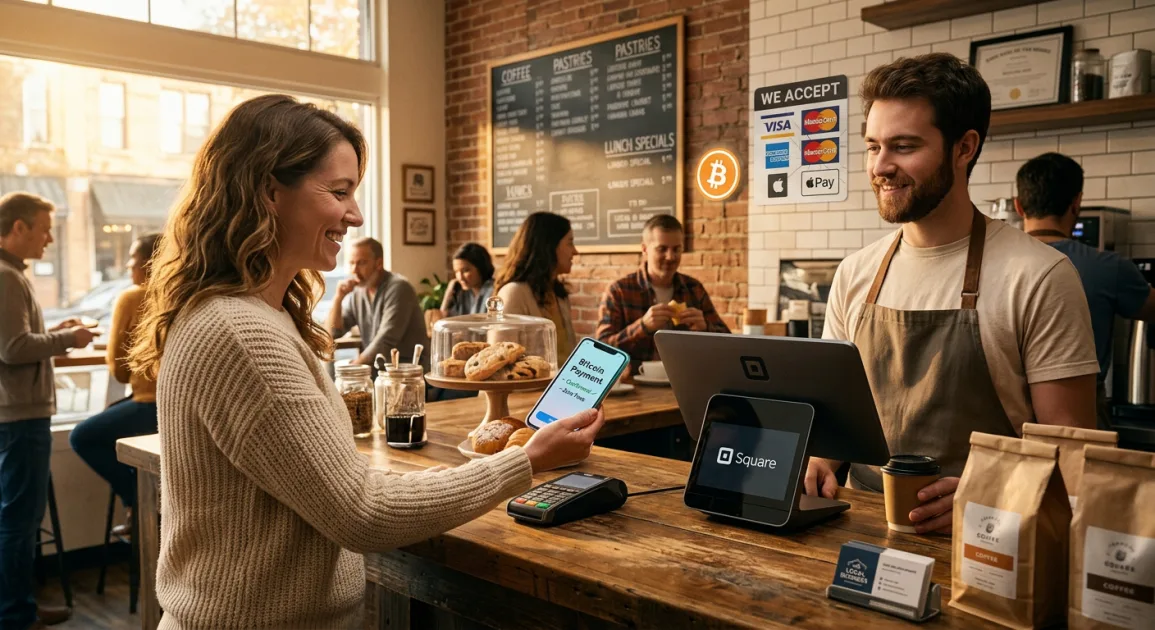
Every time you pay with a credit card or debit card, the business you are buying from does not receive the full amount. A portion — typically between 1.5% and 3.5% — is taken by the payment processing network. Visa takes a cut. Mastercard takes a cut. The bank issuing your card takes a cut. The payment processor takes a cut.
For a large corporation like Walmart, this is annoying but manageable. They process billions of dollars in transactions and have negotiated special rates. They can absorb the cost.
For a small business owner — a restaurant, a boutique, a barbershop — paying 2% to 3% on every single transaction is genuinely painful. Collectively, American merchants pay something like $160 billion a year in payment card transaction fees.
$160 billion. Every year. Taken from businesses — most of them small — and handed to banks and payment networks that built an infrastructure in the 1960s and have been collecting rent on it ever since.
Square Bitcoin payments carry zero processing fees until 2027, when a 1% charge will apply — still dramatically lower than the 1.5% to 3.5% that traditional card payments cost.
That difference — even just 1% — represents real money for real businesses. A restaurant doing $500,000 a year in sales saves $5,000 with a 1% fee versus 2%. That is a part-time employee. That is new kitchen equipment. That is the difference between a profitable year and a loss.
The Remarkable Feature Nobody Is Talking About
The fee savings are impressive. But the most extraordinary feature of Square Bitcoin is one that almost no financial journalist properly covered when it launched.
Merchants can automatically convert up to 50% of their daily card sales into Bitcoin, helping them diversify their savings without leaving the platform.
Think about what that means for a moment.
A small business owner — a florist, a mechanic, a bookshop owner — can now automatically put half of every day's revenue directly into Bitcoin, without doing anything. No exchange account. No crypto wallet. No manual transfers. It just happens, quietly, in the background, every night.
This is the financial strategy that until very recently was only available to sophisticated institutional investors and tech-savvy early adopters. Now it is built into the same dashboard that a florist uses to track her inventory.
Block Inc. itself holds over 8,000 Bitcoin and reported $21.9 billion in profit in 2024 — a company that practices exactly what it preaches when it comes to holding Bitcoin as a long-term asset.
The company is not just selling this idea to merchants. It is living it. And now it is giving four million small business owners the same tool.
The Law That Changed Everything
The Square Bitcoin launch did not happen in a vacuum. It happened in the context of a sweeping legal change in the United States that finally gave the crypto industry something it had been begging for over a decade.
On June 17, 2025, the US Senate passed the Guiding and Establishing National Innovation for US Stablecoins (GENIUS) Act — a landmark piece of legislation that introduced the first comprehensive federal framework for regulating stablecoins in the United States. With a bipartisan vote of 68 to 30, the bill marked a pivotal moment for the cryptocurrency industry, bringing clarity, consumer protection, and innovation to a market valued at over $200 billion.
For years, one of the biggest barriers to crypto adoption in business was simple uncertainty. Nobody knew what the rules were. Could you accept crypto payments legally? How did you handle taxes? What happened if regulators changed their minds next year?
The acceleration of crypto payment adoption in the US has coincided with the regulatory clarity introduced by the GENIUS Act, which established a federal framework for stablecoins and fiat-pegged tokens. By reducing legal uncertainty, the legislation appears to have lowered the threshold for large firms to deploy crypto payment rails at scale.
When the law passed, that uncertainty evaporated. Suddenly, businesses could accept digital payments with the same legal confidence they accept bank transfers. And the floodgates opened.
The Giants Are Coming — And Small Businesses Are Caught in the Middle
Here is the part of this story that should make every small business owner pay very close attention.
Walmart and Amazon may already be considering issuing their own stablecoins to slash payment processing fees. Store-issued stablecoins could help these retail giants bypass traditional payment networks and cut transaction fees to nearly zero — saving them billions of dollars annually.
JPMorgan, Bank of America, Citi, Walmart, and Amazon have all reportedly begun exploring stablecoin issuance to reduce transaction costs, sparking a surge of institutional momentum.
The largest corporations on earth are not exploring crypto because they find it philosophically interesting. They are exploring it because it saves them enormous amounts of money. When Walmart issues its own stablecoin and uses it to pay suppliers, process customer transactions, and manage its treasury — it cuts the middleman out entirely.
The middleman, in this case, is Visa. Mastercard. The entire card payment infrastructure that the world has relied on since the 1960s.
PayPal already processes stablecoin transactions through PYUSD, while Stripe and Visa are experimenting with on-chain settlement.
Even Visa — the very company that stands to lose the most from this shift — is experimenting with on-chain settlement. That is how certain they are that crypto payments are not going away. If you cannot beat them, absorb them.
The Numbers That Tell the Real Story
The adoption numbers are moving fast — and the direction is unmistakable.
In 2026, 50% of large businesses with more than $500 million in annual revenues have already incorporated digital assets into their infrastructure. Small business adoption has also recovered strongly, reaching 19% in 2026 after some hesitation in earlier years.
Cryptocurrency transactions currently account for nearly 26% of overall sales for companies that have fully embraced the technology — demonstrating that crypto users are not merely holding their assets as investments but are actively using them to purchase goods and services.
Research firm eMarketer projects that the number of US consumers using crypto for payments will grow by 82% between 2024 and 2026, driven by merchant tools that simplify conversion and compliance.
82% growth in two years. That is not a trend. That is a transformation.
The threat of price volatility is also beginning to diminish — with improved infrastructure, businesses can now receive crypto and instantly convert it to stable currency at the point of sale, eliminating the risk of holding volatile assets.
This was always the greatest objection to accepting Bitcoin as a business. What if the price drops 20% between the time a customer pays and the time you process your accounts? That problem is now largely solved. Accept Bitcoin, convert to dollars instantly, pay zero volatility risk.
What Is Happening Around the World
This shift is not limited to the United States. It is global — and in some parts of the world, it is moving even faster.
In El Salvador, 85% of small businesses reportedly accept Bitcoin as a form of payment. In South Africa, 17.2% of mobile transactions are now conducted using stablecoins as of early 2026. In the Philippines, cryptocurrency ownership grew to between 22% and 23% of the population — roughly 16 million users — with growth largely driven by remittance activity.
Thailand launched its "TouristDigiPay" program, allowing foreign tourists to convert cryptocurrencies like Bitcoin, Ethereum, and USDC into Thai baht via 15 licensed platforms — integrating crypto directly into its tourism economy.
A tourist landing in Bangkok can now spend Bitcoin at local businesses, converted automatically into baht at point of sale. The infrastructure for a genuinely borderless payment system is being built — piece by piece, country by country.
The Lightning Network: The Engine Nobody Talks About
Behind all of this is a technology that rarely makes headlines but is fundamental to everything working at scale. It is called the Lightning Network — and it is the reason Bitcoin payments can now be instant and cheap.
The original Bitcoin blockchain is powerful but slow. A transaction can take minutes or even hours to confirm, and fees can spike dramatically when the network is busy. For buying a cup of coffee, that is completely impractical.
The Lightning Network is a second layer built on top of Bitcoin. Transactions happen off the main blockchain — instantly, at almost zero cost — and are settled in bulk on the main chain later. It is the difference between a payment processing in 10 minutes and processing in milliseconds.
Square Bitcoin allows merchants to accept Bitcoin at checkout with instant settlement via Bitcoin's Lightning Network, with no fees until 2027.
Instant. That is the word that changes everything. When a payment is instant and free, there is no practical argument against using it. The only remaining barrier is habit — and habits change faster than most people expect when a better option becomes widely available.
The Future That Is Already Here
The story of crypto payments is often told as a future story. Someday, maybe, people will use Bitcoin to buy groceries. Someday, maybe, your local shop will accept Ethereum. Someday.
But the evidence of 2025 and 2026 tells a different story. The someday already arrived — quietly, without a dramatic announcement, while most people were focused on Bitcoin's price chart.
Four million Square merchants now accept Bitcoin. Fifty percent of America's largest companies have crypto in their payment infrastructure. The US government passed the first comprehensive stablecoin law in history. Walmart and Amazon are designing their own digital currencies. LNG spot prices in Asia jumped 140% while simultaneously stablecoin adoption surged. The Lightning Network processes payments in milliseconds.
The checkout counter — that mundane, ordinary piece of commerce that humanity has used in one form or another for thousands of years — just changed. The question is not whether crypto payments will become mainstream. They already are mainstream, for anyone paying attention.
The real question is much simpler. Will your business be ready when your customer reaches for their phone to pay in Bitcoin — and expects it to work?